For parents of children with PANS & PANDAS
Something changed in your child.
You are not imagining it.
Sudden OCD. Rage you do not recognize. Tics, regression, food refusal, overnight personality change. PANS and PANDAS are real, treatable, and more common than most doctors realize. Start here, written parent to parent.
This site covers both PANS and PANDAS. If your child's symptoms followed strep, you may be looking at PANDAS specifically. If they followed another illness or you don't know the trigger, PANS is the broader term. Everything here applies to both.
Where are you right now?
There is no wrong answer. You can change this anytime.
I think something is wrong and I'm trying to understand it
We will help you learn what PANS and PANDAS are and organize what you are noticing.
Start understanding →We're in the middle of a flare and I need help today
A flare is when PANS/PANDAS symptoms spike suddenly and are significantly worse than baseline. If that's happening now, start here.
Get help today →We have a working diagnosis and want to track symptoms
Daily logging, patterns over time, and reports for your care team.
Open the Companion app →You are not alone
This illness is happening to your whole family.
One night in December, our 8 year old said goodbye because he believed he was going to die.
He had already showered. He kissed each of us, laid down, crossed his arms over his chest, and cried himself to sleep. He was certain he was too dirty to survive the night.
01 / For Parents
It looks like behavior. It isn't.
You're watching a different child act strangely, irrationally, sometimes cruelly. It feels like they're acting up. They aren't. This illness is attacking the brain and making them do these things. You're not failing as a parent. You're caring for a child who is sick in a way that hides itself.
02 / For the Child
Their brain is lying to them.
The OCD feels real. The fear feels real. Everything that used to be a 2 is suddenly a 10. Imagine not being able to trust your own feelings while everyone you love tells you not to worry. They aren't being difficult. They're frightened of things they can't explain, and they need you to believe them.
03 / For the Siblings
They lost their brother or sister too.
Overnight, the person they shared their life with became someone mean and unrecognizable, getting all of the attention for the worst of reasons. They're scared, confused, and often quietly grieving. They need to be told this isn't their fault, and that you see them too.
Understanding
What is PANS and PANDAS?
What these conditions are, why they matter, and why parents often know before doctors do.
PANS and PANDAS are autoimmune conditions in children that cause sudden, severe neuropsychiatric symptoms following an infection or other immune trigger.¹,⁶ The brain becomes inflamed. The child you know seems to change overnight.
PANDAS (Pediatric Autoimmune Neuropsychiatric Disorders Associated with Streptococcal infections) is specifically linked to strep.¹,⁷ PANS (Pediatric Acute-onset Neuropsychiatric Syndrome) is the broader umbrella that includes other triggers like mycoplasma, flu, and other infections.²,⁶ Both are treatable. Many children improve significantly with the right care.³,⁴,⁵
The sudden-onset hallmark
The speed of change matters as much as the symptoms themselves.²,⁶
With typical OCD or anxiety, symptoms develop over weeks or months. With PANS and PANDAS, parents describe it differently:
"She was fine on Tuesday. By Friday she couldn't leave the doorway without touching it three times."
Specific, sudden, tied to a moment in time. The ability to name the week, sometimes the day, is part of the diagnostic picture. The onset often follows or coincides with an illness like strep, flu, or an ear infection.¹,²
Red flags
Signs to watch for²,⁶
Any one of these symptoms can be normal in children and usually has a simpler explanation. What matters is the pattern: several appearing together, with sudden onset, often following an illness. Document specifically when each appeared. The clustering and timing are what clinicians look for.
Behavioral and emotional
- •Sudden severe OCD: checking, counting, repeating, arranging
- •Intense new separation anxiety
- •Rage out of proportion to the situation
- •Personality change that feels like someone else
Physical and functional
- •New urinary urgency or bedwetting regression
- •Handwriting that has noticeably changed
- •Sudden food restriction or refusal
- •New motor or vocal tics
Cognitive and sensory
- •Math, reading, or memory noticeably declined
- •New sensory sensitivities to sound, light, touch
- •Difficulty organizing thoughts or following instructions
Sleep
- •Insomnia or difficulty staying asleep
- •New or dramatically worse nighttime fears
- •Inability to sleep alone after months or years of doing so
When you take this to a doctor
Your doctor may have never heard of this. That is not your imagination.
PANS and PANDAS are not yet part of standard medical school curricula. Most pediatricians, emergency physicians, and even many psychiatrists and neurologists have had little or no training in these conditions. In one parent survey, families saw up to 12 medical providers and waited an average of three years before receiving a diagnosis.¹⁰ The American Academy of Pediatrics published its first clinical report on PANDAS in March 2025.
What parents commonly hear:
"I have never seen this. It's probably just anxiety."
From A PEDIATRICIAN
"I don't believe PANDAS is a real diagnosis."
From AN ER DOCTOR
"You should see a psychiatrist. This isn't a medical issue."
From A NEUROLOGIST
Why this happens
PANS and PANDAS sit across specialty lines. They are immunological in origin but psychiatric in presentation, which means no single specialty owns them. Research is still catching up. Many clinicians trained before this body of work existed, and continuing education on it is rare. A negative throat culture often closes the conversation, even though 10 to 15 percent of healthy children are asymptomatic strep carriers and rapid tests carry a 15 to 20 percent false negative rate.
You are not exaggerating, and you are not the first family to be dismissed. The pattern is so common it is part of why we built this site.
How to advocate for your child
Bring a written timeline
Specific dates, what changed, whether it followed an illness. Specificity is your strongest tool. Print the summary from our screener if it helps.
Ask for PANS and PANDAS by name
Some providers are familiar but will not raise it unless you do. Use the names. Ask whether your provider has treated either condition.
Request strep titers (ASO and Anti-DNase B)²,⁵
A negative throat culture does not rule out strep as a trigger. Titers can reveal a recent or ongoing immune response that a swab will miss.
It is OK to seek a second opinion
If you feel dismissed, you are not being difficult. Many families find their primary PANS provider through telehealth, often outside their area.
Advocate
Language, tools, and templates
Most families need to advocate to find care. These are the tools that help you walk into a doctor's office, a hospital, or a school meeting with what you need to be heard.
Find a PANS-literate provider
How to find a clinician who takes PANS and PANDAS seriously, what to look for, and where to start.
Provider guide →Scripts for hard conversations
Copy-ready language for dismissive doctors, neurology referrals, school accommodations, and skeptical family members.
See scripts →School communication templates
Five email templates: intro to PANS, flare notification, 504 request, homework flexibility, substitute briefing.
View templates →Should we go to the ER?
Clear criteria for when to go, what to bring, and exactly what to say at intake.
Read guide →Diagnostic criteria
The clinical frameworks that clinicians use, explained in plain language with the terms defined.
Read more →Vetted external resources
PANDAS Physicians Network directory, ASPIRE, parent communities, and published research worth your time.
See list →For families ready to track
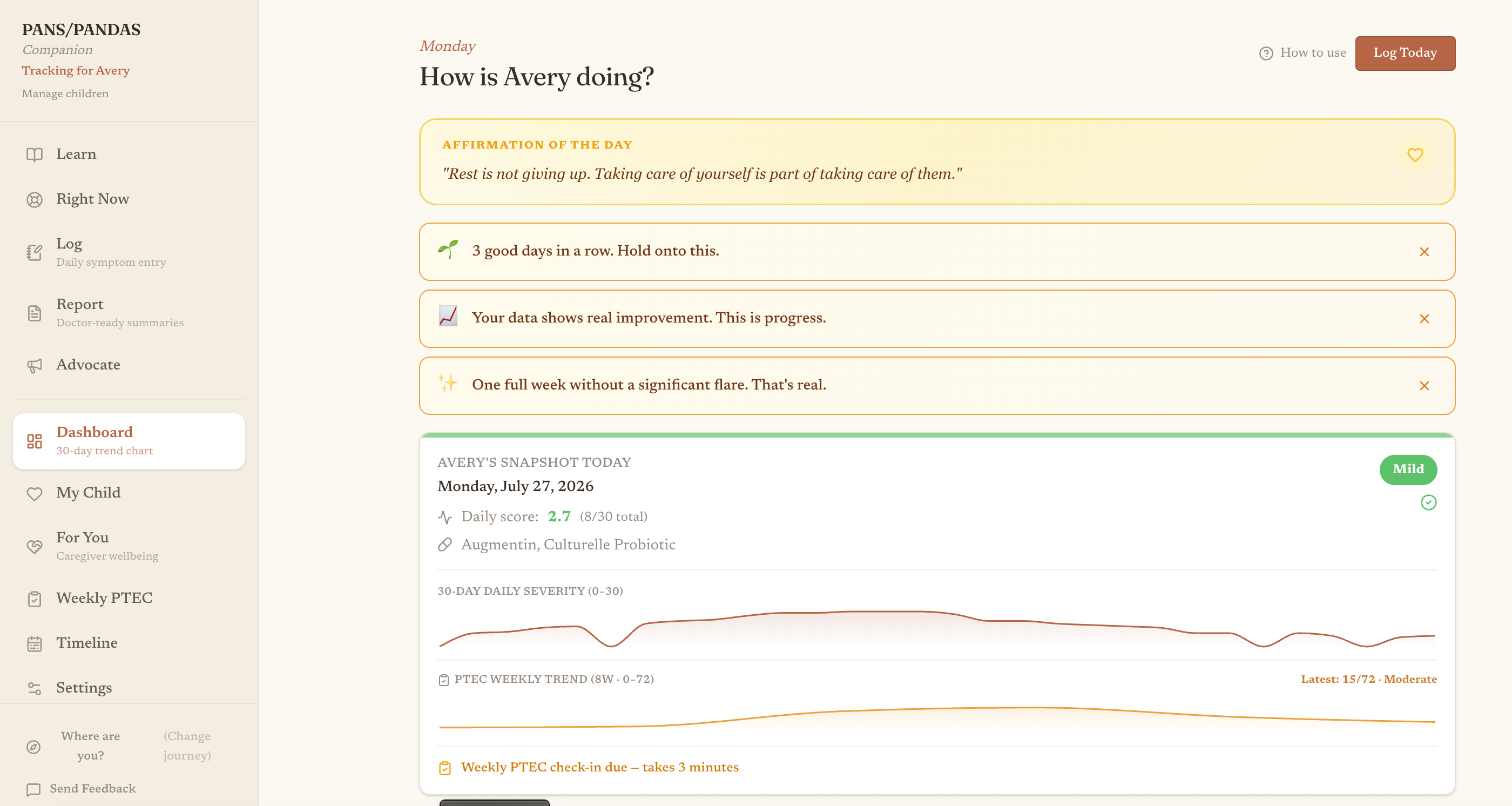
Once you have a name for it, the next problem is tracking it.
Flares look like good days, then bad weeks, then sudden plateaus. Without data you cannot tell if a treatment is working or imagine the pattern.
PANS/PANDAS Companion is the tool we built to solve that. Daily logging, flare patterns, and visit-ready reports for your care team.
Our story
We built this because we needed it.
When our child's symptoms started, we spent months in waiting rooms, on forums at 2am, and reading research papers we were not trained to interpret. We watched our child change overnight and felt like no one believed us. This site, and PANS/PANDAS Companion, are what we wish had existed.